Why Choose Frameless Design?
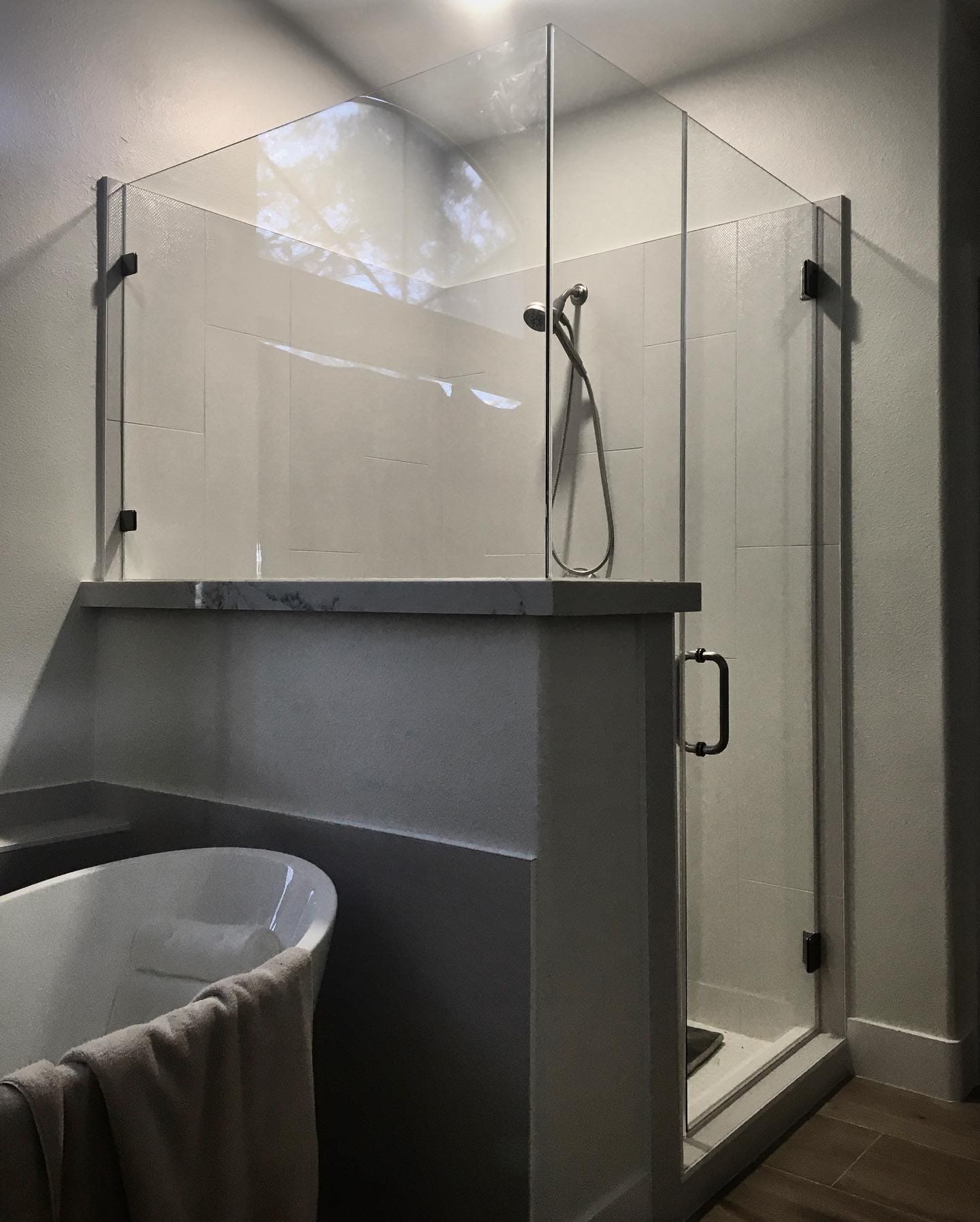
Clean lines, maximum light, and easier cleaning make frameless doors the premium choice.
Premium Glass Options
3/8" or 1/2" tempered safety glass with optional low-iron ultra-clear upgrade
Premium Hardware
Heavy-duty hinges, handles, and mounting systems in multiple finish options
Custom Fabrication
Precision-cut to your exact measurements in our local Las Vegas shop
Frequently Asked Questions
What glass thickness is best for frameless doors?
Frameless doors carry their own weight, so thickness is structural rather than cosmetic. 3/8 inch (10mm) tempered glass is the standard and handles the great majority of residential openings: it is rigid enough to hang from hinges without flexing, and it keeps both the glass cost and the hardware cost down. 1/2 inch (12mm) is worth the upgrade on wide or tall panels, on doors over about 30 inches of leaf width, and on anything reaching toward a 9 or 10 foot ceiling, where the extra rigidity stops the panel feeling springy when it swings. Half-inch glass is also noticeably heavier, which means heavier hinges and more attention to what is behind the tile, so we confirm the wall framing before quoting it. We will tell you at the measure which one your opening actually needs.
How long do frameless shower doors last?
The glass itself does not wear out. Tempered glass has no moving parts and no coating to fail, so a frameless panel that is properly installed and never struck on an edge will outlast the bathroom around it. What ages is the hardware and the seals: hinges can loosen, and the clear vinyl sweep along the bottom of the door goes brittle and needs replacing every few years, which is a ten-minute job and an inexpensive part. In practice most frameless enclosures we install are still in daily service fifteen to twenty years on. The realistic risk is not age but edge damage: tempered glass is very strong across its face and vulnerable at the exposed edge, which is why we polish every edge and why a chipped edge should be looked at rather than ignored.
Can frameless doors work with any shower layout?
Almost always, because every panel is cut for your opening rather than pulled from a stock size. We fabricate for alcove openings with a single door, corner enclosures with a return panel, neo-angle showers with an angled front, walk-in and single-panel screens with no door at all, and steam enclosures that run to the ceiling with a transom. The layouts that need a conversation are the ones where the glass has nothing solid to hang from, or where the curb or pan slopes enough that the door would swing into the floor. Out-of-plumb walls are not a problem in themselves, and are extremely common in Las Vegas tract construction. We laser-measure the opening rather than assuming it is square, and the glass is cut to the walls you actually have.
What hardware finishes are available?
We stock polished chrome, brushed nickel, matte black and brushed brass, and can order oil-rubbed bronze, satin brass and champagne bronze for a custom order. The practical advice is to match the shower hardware to the fixtures already in the room rather than to the vanity or the lighting, since the eye reads the shower valve and the door hardware together. Chrome and brushed nickel are the safest choices in a bathroom you may sell; they disappear against almost anything. Matte black is the strongest visual statement and shows water spots most readily, which matters more here than elsewhere because Las Vegas has some of the hardest water in the country. Brushed finishes hide spotting better than polished ones. We bring finish samples to the measure so you are choosing against your own tile and light, not a photograph.
Do frameless doors leak water?
A correctly installed frameless door does not leak, but it is worth understanding why, because frameless enclosures manage water differently from framed ones. A framed door relies on an aluminium track to catch and drain water. A frameless door has no track: it relies on the door sitting in the correct plane, a clear polycarbonate sweep along the bottom edge, and a seal strip where the door meets the fixed panel. Get those three right and water runs back into the pan. Get the pitch of the pan or the swing of the door wrong and it will not, no matter how good the glass is. This is the single most common failure we are called out to fix on someone else's installation, and it is almost always a fitting problem rather than a product problem.
Last updated